
Defence leaders, innovators, investors and farmers shared what it will take to turn Canadian technology into real-world capability that strengthens Canada’s sovereignty.
By: Randy Gaudreau
Canada’s innovators are moving fast. The question at GCXpo 2026 was whether procurement and adoption can keep up.
Held September 29 at the Area X.O Greenbelt site in Ottawa, the event drew more than 2,300 attendees, with more than 100 Canadian companies demonstrating technologies across defence, dual-use innovation and smart agriculture.
Founded and operated by Invest Ottawa, Area X.O is a next-generation R&D complex and NATO DIANA Test Centre that helps innovators get to market faster and safely by working directly with end users.
From procurement and testing to financing and farm adoption, speakers shared practical insights on what it will take to close the gap.
 “Canada has ambitious innovators, founders and companies, extraordinary talent, and bold technology. Our opportunity is to get it into the world even faster,” said Sonya Shorey, President and CEO of Invest Ottawa, Area X.O and Bayview Yards, in her opening remarks on the Accenture Defence Innovation Stage.
“Invention sitting on a shelf does not strengthen our sovereignty,” she added. “A prototype does not increase productivity. Promising technology does not build a company. Adoption does.”
Shorey framed the day around the full path from idea to impact: build it, test it, prove it, trust it, buy it, deploy it and scale it. The goal at every step is to make sure Canadian technologies are the ones chosen – whether for Canada’s forces, its allies or its farmers.
Build it: Start with the mission
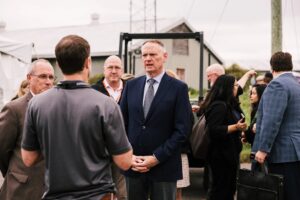
The Honourable David McGuinty, Minister of National Defence, said rebuilding Canada’s defence is about more than spending more. “It’s about getting more capability from every dollar we invest,” he said. “Shortening the distance between a good idea and an operational capability.”
He pointed to Canada’s Defence Industrial Strategy and its “build, partner, buy” approach, which prioritizes building at home where possible, partnering with trusted allies next, and buying from third parties only when needed. “Every major defence investment should leave Canada stronger than it found it,” McGuinty said.
He was also candid about where the pressure sits. “The question is whether our systems can move as quickly as our innovators do,” he said. “That’s the standard government has to meet.”
Test it: Get technology in front of operators early
On the first panel of the day, “From Innovation to Operational Capability” panellists explored what the Canadian Armed Forces need from industry, and how to get it there faster.
A few priorities emerged from the discussion:
 Build relationships, not transactions. Lieutenant-General Darcy Molstad, Commander of Canadian Joint Forces Command, said technology is changing too quickly for either side to wait for perfect answers, calling for relationships that are “transformational instead of transactional.” In his words: “Good enough today is much more preferable than perfect tomorrow.”
- Show the system can move. Molstad pointed to the Defence Drone Initiative, which went from a standing start to a supply arrangement with 399 prequalified vendors in about two and a half months, with companies given five days to respond to requests for proposals.
- Don’t build in isolation. Mitch Carkner, Chief Operating Officer of Dominion Dynamics, cautioned against “having a conviction on an idea and building it without going back to the war fighter for feedback.” His team recently spent two weeks in Latvia putting hardware in front of Canadian troops, then returned home to improve it.
- Plan for constant change. “The change now comes in days,” said Eva Sula, a NATO and EU innovation advisor. Pointing to lessons from Ukraine, she noted that electronic warfare can make technology obsolete almost overnight.
 Build relationships, not transactions. Lieutenant-General Darcy Molstad, Commander of
 Real-world conditions bring their own surprises. Later in the day, on the “Tested Before Trusted” panel, Kevin Toderel, CEO of Remote Robotic Systems Inc., was asked what tends to fail when technology moves from a controlled demonstration into the real world.
His answer, with a laugh: “literally everything.” He described a system his team had fully tested in the lab, only to burn out every motor during a final test flight on a windy day, just before it was due to ship. It’s the kind of failure real-world testing is designed to catch before technology reaches the field.
Trust it: Build evidence that travels
The rest of that panel explored what governments and investors need to see before they commit.
Glen Lynch of Volatus Aerospace said that even after a system performs well in testing, government still needs proof a company can produce at scale, train users, supply spares, manage cyber risks and keep the technology current.
“We’re not buying drones. We’re buying capability,” he said.
Panellists debated how high the bar for evidence should be. Paul Ziadé, CEO of North Vector Dynamics, argued that if government wants to engage earlier-stage companies, it will need to accept less mature evidence. He also called for a culture that accepts risk, noting that high-profile procurement failures have left government wary of trying new things.
His answer is to fail smaller and earlier.
“We need to be failing at the $500,000 procurement mark,” he said, adding that decision makers like Molstad need cover when and if experiments don’t work out, as part of the process, and suggests a change of culture is needed.
Asked whether a more standardized validation pathway could help Canadian companies access capital sooner, Peter Dawe of BDC said the strongest signal is whether troops are actually using a technology, which is also the first question international buyers ask, is anyone using it?
“You got your corporals out there putting their hands on it? I would invest in that,” he explained.

He also reiterated on the theme that in the current defence environment, speed can outweigh getting things perfect.
“Let’s just back off the pursuit of perfection,” he said. “Speed is of the essence, and perfection is the enemy of good enough, and getting things done. So, we need to recalibrate the risk aperture there a little bit.”
Moderator Rebecca Thompson, Director of Defence Programming and Operations at Area X.O, summed up where the panel landed: faster procurement does not mean lowering the standard.
It means being clearer about what evidence is needed, when it is needed and what decision it supports, so strong Canadian technologies don’t have to prove themselves from scratch at every step.
Buy it: The Canadian customer has to show up
On the “Sovereignty by Design” panel, moderator Jennifer Stewart, Founder and CEO of Syntax Strategic, pushed panellists to define sovereignty beyond a buzzword.
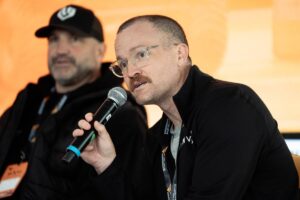 For Sam Witherspoon, CEO of ANVIL, the answer starts with purchasing.
“We actually have to buy stuff from Canadian companies,” he said. “If we’re going to build sovereign capability, then the Canadian customer needs to show up.”
Glenn Cowan of ONE9 agreed that revenue is what makes sovereignty sustainable.
“Until we’re serious about actually delivering meaningful revenues to our companies, we can be as sovereign as we want. It won’t matter,” he said. He also cautioned that Canadian capabilities need to work alongside allied systems from the start.
Earlier in the day, on the “From Innovation to Operational Capability” panel, General (Ret’d) Rick Hillier proposed giving senior commanders dedicated budgets to buy Canadian technology for operational use, not just for testing.
“Not buy the test, buy the use,” he said, noting that being in service with the Canadian Armed Forces can dramatically raise a company’s credibility with buyers abroad.
The same challenge in the field
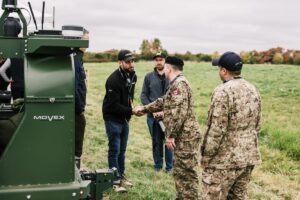
The adoption gap doesn’t stop at the battlefield. It reaches the farm field too.
And like defence, agriculture is a matter of sovereignty: Canada’s resilience depends not only on protecting its borders and infrastructure, but also on securing the systems that feed its citizens and communities.
On the Farm Credit Canada (FCC) Agtech Stage, keynote speaker Kim McConnell called on the agriculture sector to turn its advantages into results.
“We have an opportunity. Let’s not waste that opportunity,” he said. “Let’s put the pieces together so that we can be strong.”
Graham Millen of FCC explained that “adoption happens at the speed of trust,” and that farmers need answers to two questions before adopting something new: does it work, and does it work for me?
That is the purpose of the FCC AIVA Network (Agriculture Innovation, Validation and Adoption Network), which launched in May and ran nine validation projects across four innovation farms in its first season, including the Smart Farm at Area X.O.
On an FCC Agtech Stage panel moderated by Susanne Cork, Business Development Director, Smart Farm and Advanced Robotics, Area X.O, panellists described many of the same challenges heard on the defence stage, starting with time.

Where defence technology can change in days, agriculture runs on a seasonal clock.
Asked what innovators often misunderstand about bringing technology onto a working farm, Chuck Baresich, a southwestern Ontario farmer and founder and president of Haggerty AgRobotics, pushed back on the perception that agriculture is slow to adopt new technology.
“It’s not that farmers are slow,” he said. “We have one chance to grow a crop every year.”
If a trial doesn’t work, the next opportunity may be a full season away. He urged innovators to plan for longer validation timelines and make sure they can sustain their business until their technology is proven.
Farmers also want the same kind of proof defence buyers do. Laura Neil of Northern Roots Soil Solutions said farmers want innovators to break down the costs, the return on investment and how long a technology takes to pay for itself.

“I want to know on a bad day,” she said. “I don’t want to know the best day or the average day.”
Later, at the “Farmer’s Open-Mic Reverse Pitch”, the microphone was passed to producers to tell innovators what they actually need.
Several barriers will sound familiar from the defence stage, from systems that don’t talk to each other to unreliable connections in the field. Producers also pointed to high costs for smaller operations and limited access to repairs during critical windows.
One farmer saw the overlap as an opportunity, noting that much of the defence technology on display across the site had potential to be adapted for agriculture, when viewed with the right lens.
“I see so many applications, not in warfare, but in farmfare,” they said.
Deploy and scale: Building irreversible momentum
Throughout the day, speakers agreed the window for change is open but will not stay open on its own.
“We have to establish irreversible momentum,” Molstad said, warning that without it, Canada could fall back into “fits and starts.”
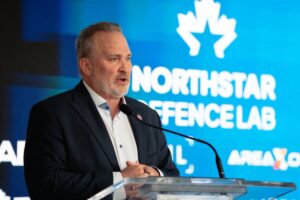
That momentum was on display at GCXpo itself. Calian and Invest Ottawa announced the launch of the Northstar Defence Lab at Area X.O, the first facility in Calian’s planned nationwide network of regional defence development labs, where Canadian companies can bring their technologies together and test them as integrated capabilities.
Chris Pogue, President, Defence and Space at Calian, said Calian VENTURES, launched in Ottawa a year earlier to help Canadian small and medium-sized enterprises turn prototypes into mission-ready defence capabilities, has since engaged nearly 150 of those companies.
Drawing on his time in uniform and two decades in industry, he said progress rarely feels fast in the moment.
“Looking forward, it always seems that nothing is moving as fast as it could,” he said. “And then looking backwards, one year later, I’m surprised by how fast everything is moving. Faster than I thought it could.”

Throughout the conversations of the day, it seems that keeping that pace will take everyone in the room.
Shorey opened the day with a direct ask of attendees, which rang true in the wake of the event: don’t just look at the technology, put it to work, right here in Canada.
“Find the problem, meet the innovator, test the solution,” she said. “Build it here, test it here, buy it here. Deploy it here and scale it to the world.”
Learn More and Explore
- Discover how Ottawa-Gatineau, home to Canada’s national defence leadership,is advancing as Canada’s defence innovation hub at dihub.ca.
- Learn how Area X.O helps Canadian innovators move technologies from development and testing to commercialization and adoption.
- Read about Canada’s selection as host country for the multinational Defence, Security and Resilience Bank, a new institution designed to finance defence, security and resilience capabilities and accelerate investment in critical and dual-use technologies.







 Shoebox enables hearing care around the world. It creates, sells, and supports products that help clinicians identify hearing loss. The maker of Shoebox, Clearwater Clinical, hit a huge milestone in 2018 when they entered a strategic partnership with international hearing device company
 Transforming our data-driven world takes talent, and MindBridge is where it’s happening. This is where you’ll take artificial intelligence to enable and inspire humans to do more and be better. Our people, our customers, and our investors agree: No one else is accomplishing what we’re doing with data-driven AI right now.
  Tehama is enabling the digital workplace of the future. 150 companies are using Tehama. 600,000+ hours of IT services delivered. Zero breaches. The company’s head office is in the heart of the highly desirable Westboro neighborhood of Ottawa where you have your pick of the best of Ottawa’s cafes, restaurants and shops. Prefer to work from home? Tehama offers remote working options and flexible core hours. Join a team of the best and brightest and enjoy competitive salaries, benefits and a commitment to YOUR long-term success.
  Spartan Bioscience aspires to unleash the power of DNA testing for everyone. Like the Spartan warriors of Ancient Greece, our smart, hard-working, and honorable team members get things done. Learn