
There are a lot of things to love about living in Ottawa — from the thriving business community to the multicultural citizenry to the beautiful greenspace that we’re all privileged to live next to.

Ottawa, the capital of Canada, is nestled peacefully along the Ottawa River. It’s home to more than a million people and boasts an exceptionally high standard of living for a city of its size.
Opportunities are boundless in Ottawa, with a world class tech and government sector, and booming local business scene right at your doorstep. It’s why immigrants from all over the world come to Ottawa, and what makes it such an attractive place to live.
Despite being smaller than sibling cities like Toronto or Montreal, there is no shortage of options for where to live in Ottawa. There are expansive neighbourhoods to the west and east of the downtown core, along with satellite towns that act as feeders into the nation’s capital.
With so many great locations, it can be hard for newcomers to decide.
This guide will profile the must-know neighbourhoods in Ottawa’s west end, including those close to downtown and those further out.
We’ll share typical housing costs, pros and cons, commute times, and notable amenities for each, giving you all the information you’ll need to make an informed decision for your family.
What is Ottawa’s West End? The Greenbelt Defines the Borders
To understand Ottawa’s geography, you need to know about the Greenbelt.
The city limits of Ottawa are shaped like a big heart, covering almost 2800km of space just south of the Ottawa River. Generally, the west end of Ottawa falls into three distinct rings within that heart, with the Greenbelt defining each neighbourhood within it.
What is the Greenbelt?
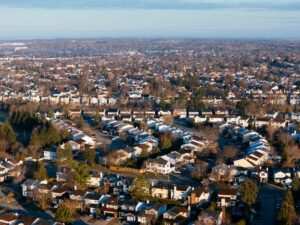
Aerial view of a Barrhaven suburban housing development in Ottawa.
The Greenbelt is a protected band of farms, forests, and wetlands that circles the city, covering about 20,000 hectares. The federal government set this aside in the 1950s to keep the capital compact, and the National Capital Commission (NCC) still owns most of it. The NCC describes it as the largest publicly owned greenbelt in the world.
The inner west ring, inside of the Greenbelt, includes bustling Westboro and Hintonburg, each of which sit just outside of downtown. Beyond that sit Nepean and Bells Corners, each sitting on the inner edge of the Greenbelt.
Further down Highway 417, beyond the Greenbelt, lie Kanata, Stittsville, and Barrhaven — each a major suburb that includes expansive housing, business hubs, and amenities. These suburbs have expanded significantly in recent decades, fueled by Ottawa’s rapid population growth.
How do Ottawa’s West End Neighbourhoods Compare?
Each of Ottawa’s west end neighbourhoods has something to offer for families. What makes one area better depends entirely on a combination of housing budget, desired amenities and lifestyle, and ideal commute time.
Like most cities, housing prices climb the closer you get to the downtown core, with options primarily for condos and older homes. Conversely, homes get newer and bigger the further you move away from it, with costs decreasing. Commute times also ramp up significantly for neighbourhoods beyond the Greenbelt — especially for those who work downtown.
To help you decide, here’s a summary table that helps you compare housing types, costs, commutes, and transit options.
One number worth remembering as you read:the average Ottawa home sold for $688,253 in August 2026, roughly 30% less than the Toronto average that same month.
| Community | Typical homes | Approx. avg. price | Morning drive to downtown | Transit today | Best suited to |
|---|---|---|---|---|---|
| Hintonburg | Older homes, infill, condos | Condos ~$640K
Detached ~$875K |
7 to 22 minutes | Direct bus (Route 11), or the O-Train from Bayview or Tunney’s Pasture | Walkability, restaurants, and the best transit in the West End |
| Westboro | Older homes, infill, condos | Condos ~$550K,
Detached $1.2M+ |
10 to 28 minutes | Direct bus (Route 11), or a bus to Tunney’s Pasture | Urban living near the river |
| Nepean | Mid-century detached and townhouses | Townhouses ~$620K
Detached near $1M |
18 to 45 minutes | Transitway bus from Baseline to Tunney’s Pasture | A central location near major government employers |
| Bells Corners | Mid-century detached and townhouses | Townhouses ~$520K, detached ~$770K | 24 to 55 minutes | Route 57 to Tunney’s Pasture | The lowest prices in the West End, with nature trails on your doorstep |
| Kanata | Newer detached and townhouses | Townhouses ~$600K
Detached ~$910K |
26 to 60 minutes | Bus to Tunney’s Pasture, with express buses at peak | Tech jobs, new schools, and an established newcomer community |
| Stittsville | Newest detached homes | Townhouses ~$645K
Detached ~$935K |
30 to 65 minutes | Route 61 or 62 to Tunney’s Pasture | The newest homes, with small-town roots |
| Barrhaven | Newer detached and townhouses | Townhouses ~$565K
Detached ~$810K |
30 to 75 minutes | Transitway bus (75 or 80) to Tunney’s Pasture | Young families and new schools, at a lower price than Kanata |
Note: The housing prices above are approximate average sold prices for the 12 months to August 2026, drawn from Multiple Listing Service (MLS) data compiled by a local brokerage. The drive times are taken from Google Maps, and reflect typical weekday traffic volumes during the morning peak and drive times to Parliament Hill.
Exploring Ottawa’s West End Neighbourhoods
Housing costs, commute times, and transit options are important to know, but they don’t give you the full picture of what it’s like to live in a neighbourhood. Let’s explore what makes each neighbourhood special.
The Inner Ring: Westboro and Hintonburg
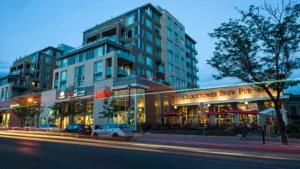
Westboro and Hintonburg are two of the most sought-after addresses in the city, with walkable main streets, restaurants you’ll want to try twice, and a commute downtown that’s measured in minutes rather than highway exits.
They’re also the oldest part of the West End.
According to the 2021 Census, 43% of the homes here were built before 1961, compared with 16% across the city as a whole. That history gives the neighbourhoods character, but also comes with a heftier price tag and smaller properties than almost anything you’d get further west.
Westboro

Westboro is like a riverside village that happens to sit inside a capital city.
Richmond Road, its main street, has more than 200 shops and businesses and a Saturday farmers’ market from May to October. Westboro Beach is a short walk from most of the neighbourhood, with lifeguards through the summer, a café, and paddleboard rentals on the river.
Westboro is beautiful, and part of what makes Ottawa so special. But it comes with a price. Detached homes in Westboro average more than $1.2 million, though condos come in around $550,000—a realistic entry point for a smaller family.
Tunney’s Pasture, the federal campus that houses Statistics Canada and Health Canada, is next door, so plenty of residents walk to work.
Hintonburg
Hintonburg is the best-connected neighbourhood in this guide, and the more affordable of the two inner-ring options if you’re buying a house. Wellington Street West runs through the middle of Hintonburg, with more than 550 businesses along the way, including the century-old Parkdale Market.
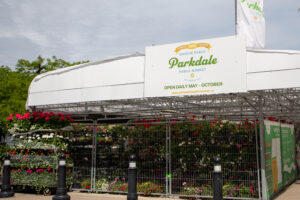
Parkdale Market in the Hintonburg neighbourhood of Ottawa.
A Wellington West address scores 99 out of 100 on Walk Score, just ahead of Westboro’s 97. Detached homes average about $875,000 here, well under Westboro’s.
Two O-Train stations are within walking distance, Bayview and Tunney’s Pasture, making it one of the few west-end neighbourhoods where a family can manage with one car or none.
The Ottawa Hospital’s Civic Campus is minutes away, and the Ottawa Community Immigrant Services Organization has an office on Wellington Street West.
The Greenbelt’s Edge: Nepean and Bells Corners
For many newcomers, this middle ring provides the right balance to suit their needs. Homes here went up mostly between 1961 and 1980, so you get mature trees, established streets, and more space than the inner ring, without the drive that comes with the outer suburbs.
It’s also closer to work than most people expect. The federal government anchors employment in this part of the city, with National Defence headquarters on the Carling campus at Moodie Drive, and the head offices of the Public Health Agency of Canada and the Canadian Food Inspection Agency near Merivale Road.
Nepean
Nepean is the closest of the west-end suburbs to downtown, at 18 to 45 minutes to Parliament Hill in morning traffic. A quick note on the name.
In this guide, Nepean means the established neighbourhoods of the former City of Nepean that sit inside the Greenbelt, including Centrepointe, Craig Henry, Crestview, and Qualicum. The old city also took in Barrhaven and Bells Corners before it joined Ottawa in 2001, so you’ll see the name used both ways.
For families, the draw is everything within a few minutes’ drive. The Nepean Sportsplex has a 50-metre pool with diving towers, three arenas, and a 10-sheet curling centre, and the Nepean Centrepointe library runs a makerspace and free tutoring.
Algonquin College and Ottawa-grown Ross Video are both major local employers, and the YMCA-YWCA Newcomer Information Centre at Merivale Mall offers free, multilingual help with settling in.
Townhouses average around $620,000 here, with detached homes closer to $1 million.
Bells Corners
Bells Corners is an island in the Greenbelt, and the most affordable community in this guide.
NCC land wraps around it on every side, and Stony Swamp’s more than 40 kilometres of trails make it the perfect blend of suburban living and greenspace. Townhouses average about $520,000 and detached homes about $770,000, which buys noticeably more house than the same money does in Nepean.
The community has been here a while, growing up around a tavern Hugh Bell ran from 1834. General Dynamics Mission Systems–Canada employs roughly 1,400 people on Robertson Road today.
The trade-off is the commute, which runs closer to Kanata’s than to Nepean’s. So the case for Bells Corners is space and affordability rather than proximity.
Beyond the Greenbelt: Kanata, Stittsville, and Barrhaven
Past the Greenbelt, you enter the world of Ottawa West’s major suburbs. Homes are newer and bigger, streets are full of kids, and the schools are the newest in the city.
Kanata

Kanata is the West End’s job centre, and for a lot of families that’s the deciding factor.
Developer Bill Teron announced the new suburb in 1964 as “a city in the country”, and its northern edge is now the Kanata North Tech Park.
This bustling tech hub is home to more than 800 companies and about 31,000 people working there.
Nokia, Ericsson, and Ciena run major research operations in the park, alongside Ottawa-grown firms like Solace and startups in the Hub350 space.
It’s also a well-established landing spot for newcomers. In the Kanata North ward, 37% of residents are immigrants, according to the 2021 Census. Detached homes average about $910,000, and the drive downtown runs 26 to 60 minutes depending on the day.
Stittsville
Stittsville is growing faster than any other part of the west end. It grew 36% between 2016 and 2021, four times the city’s rate, and the City projects the Stittsville ward will grow another 68% by 2034, more than any other ward in Ottawa.
Underneath the new subdivisions is a real village, with a distinct and charming downtown and walkable streets lined with shops. Most residents work next door in Kanata West, home to the Kinaxis and Calian headquarters.
The trade-off is distance—detached homes average about $935,000, and the morning drive downtown runs 30 to 65 minutes.
Barrhaven
Barrhaven sits southwest rather than west, but nearly every family shopping for homes in the West End ends up comparing it with Kanata. The two are similar,young, full of families, and well supplied with new schools,but Barrhaven’s detached homes averaged about $810,000 in August 2026, roughly $100,000 less than Kanata’s.
It’s the youngest community in this guide, with 22% of residents in Barrhaven under the age of 15, and one of the most diverse, with immigrants making up 37% of the population. Families in this suburb get easy access to Walter Baker Sports Centre, the Minto Recreation Complex, and VIA Rail’s Fallowfield station for trips to Toronto or Montreal.
Work is increasingly local too, including Amazon’s robotics fulfilment centre on Citigate Drive, which employs more than 2,500 people. Residents also have short drives to Kanata’s tech park and to government campuses in the west end.
Commutes to downtown, though, are the longest in this guide at 30 to 75 minutes in the morning and up to 85 minutes coming home.

Which Ottawa Neighbourhood Is Right for Your Family?
The right choice comes down to what you want most as a family.
If it’s a short commute and a walkable street, look inside the Greenbelt at Hintonburg and Westboro. If it’s established streets and a central location at a fair price, look at its edge in Nepean and Bells Corners.
If it’s space, new homes, and new schools, the suburbs beyond the Greenbelt are built for exactly that.
Regardless of where you land, the good news is that you’ve chosen to live in a truly special city with boundless amenities, opportunities, and space. Ottawa truly has become a world class city, and we can’t wait to have you join us here.
Ready to make the move? Browse current openings on the Work in Ottawa jobs board, or join our talent pool to get on the radar of employers hiring across the city.







 Shoebox enables hearing care around the world. It creates, sells, and supports products that help clinicians identify hearing loss. The maker of Shoebox, Clearwater Clinical, hit a huge milestone in 2018 when they entered a strategic partnership with international hearing device company

 Transforming our data-driven world takes talent, and MindBridge is where it’s happening. This is where you’ll take artificial intelligence to enable and inspire humans to do more and be better. Our people, our customers, and our investors agree: No one else is accomplishing what we’re doing with data-driven AI right now.
 Tehama is enabling the digital workplace of the future. 150 companies are using Tehama. 600,000+ hours of IT services delivered. Zero breaches. The company’s head office is in the heart of the highly desirable Westboro neighborhood of Ottawa where you have your pick of the best of Ottawa’s cafes, restaurants and shops. Prefer to work from home? Tehama offers remote working options and flexible core hours. Join a team of the best and brightest and enjoy competitive salaries, benefits and a commitment to YOUR long-term success.
 Spartan Bioscience aspires to unleash the power of DNA testing for everyone. Like the Spartan warriors of Ancient Greece, our smart, hard-working, and honorable team members get things done. Learn